The Fountain in Front of Saarbrücken Castle
The Fountain in Front of Saarbrücken Castle
A Modern Accent in a Historic Setting
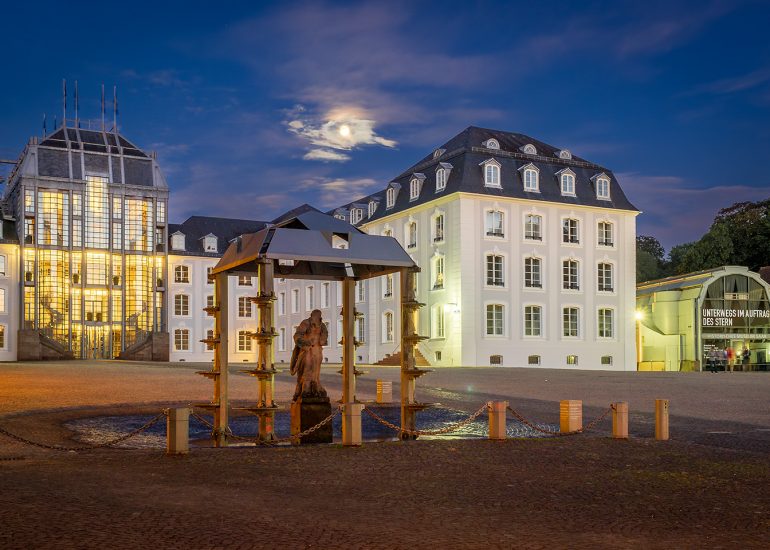
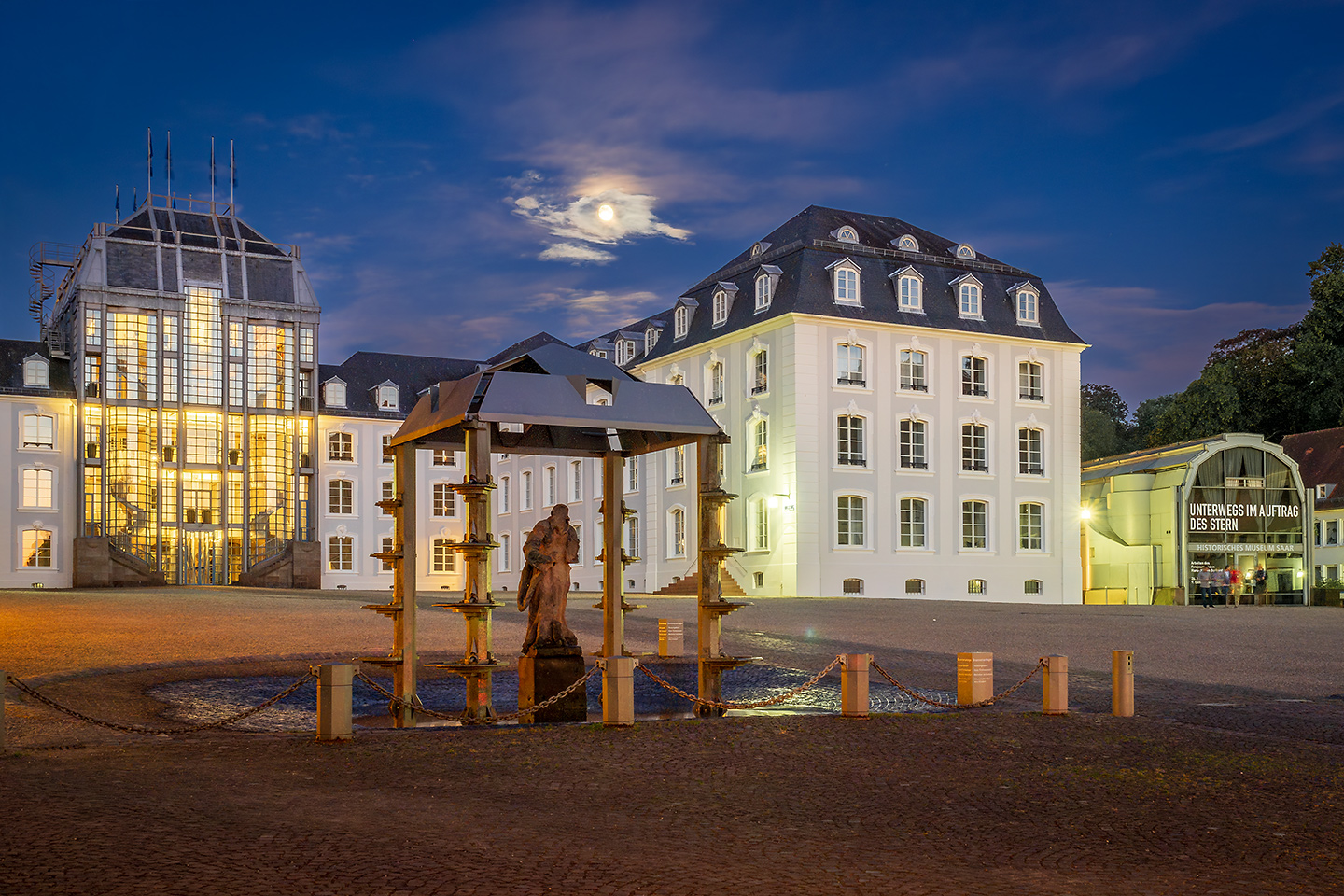
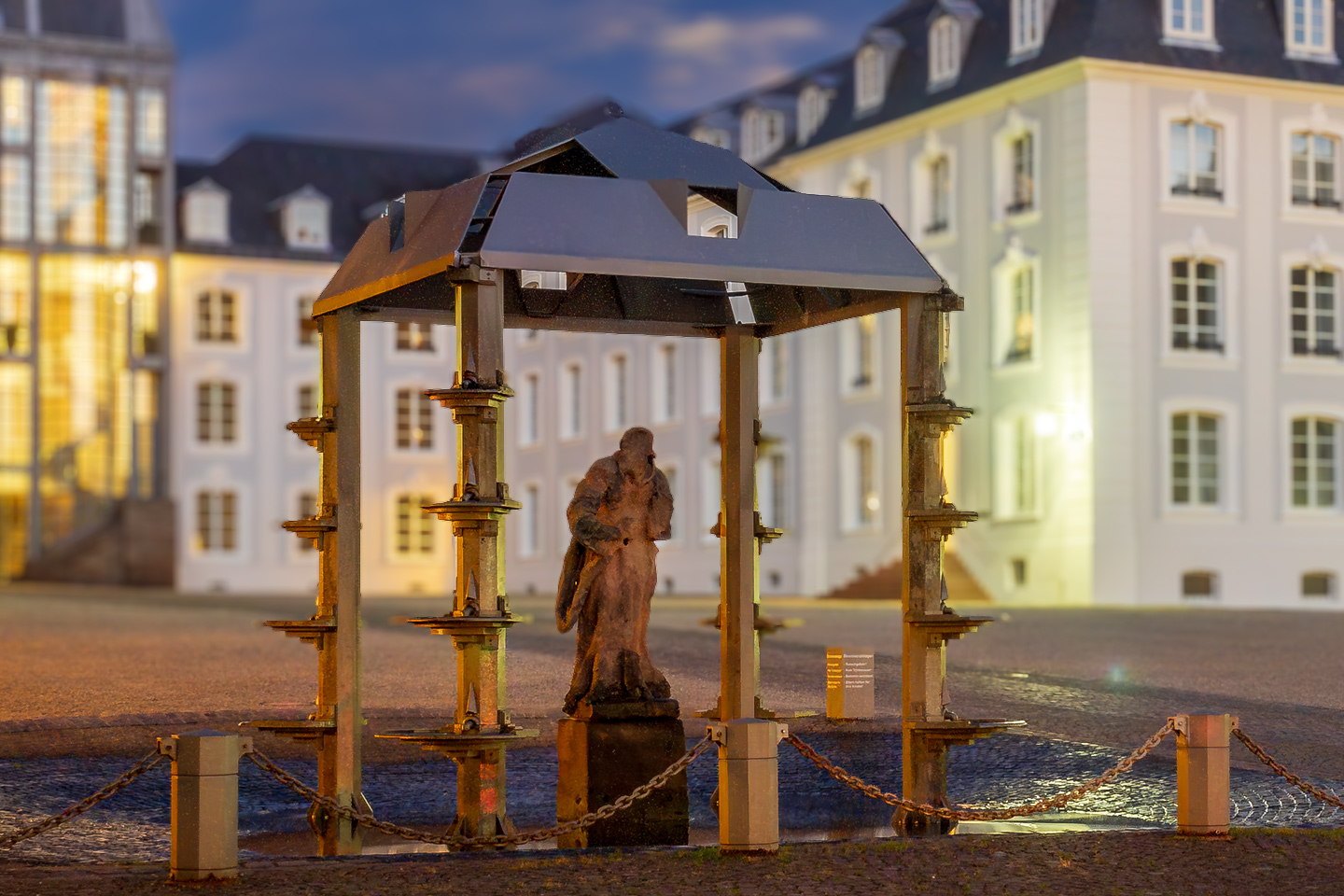
On the left side of Saarbrücken’s Schlossplatz, between the “Alte Sammlung” and the adult education centre, stands a striking, modern fountain. It occupies precisely the spot where Friedrich Joachim Stengel, during the construction of the castle (1739–1748), erected one of his two octagonal guardhouses—integrated into the fence of the outer castle courtyard. [1]
Gottfried Böhm and the Reinterpretation of the Guardhouse
The present fountain was designed by Gottfried Böhm of Cologne, a member of the architectural partnership Böhm, Rosiny, Krüger and Rieger. This group won the competition for the extensive renovation of Saarbrücken Castle (1982–1989), implementing the concept of restoring the baroque wings and reinterpreting the central building with a glass envelope. [2]
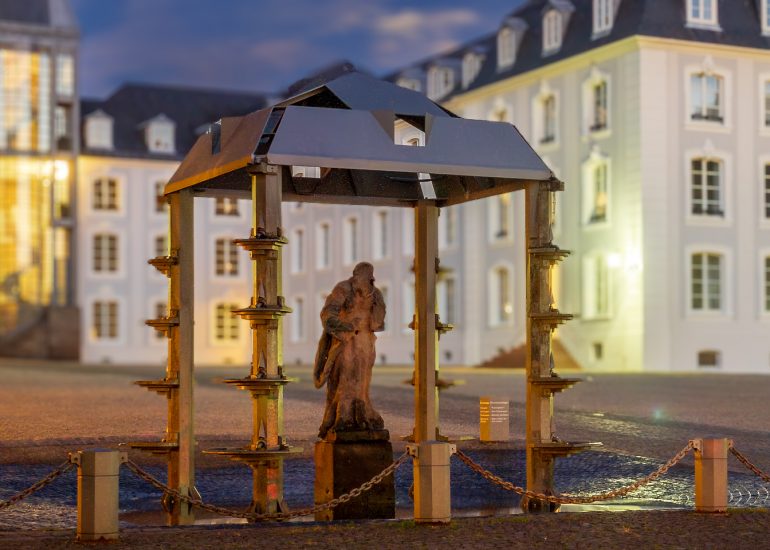
Böhm also modelled the fountain closely on the historical dimensions of the former guardhouse. The roof structure and spatial impression were modernised and stylised:
Four octagonal steel columns support a roof from which water gushes over the edges. Attached to the columns are four bowls that increase in size from top to bottom. They slow the fall of the water and guide it into a wide, sweeping motion. The paved depressions in which the columns stand serve as catch basins. [2]
The statue of the Apostle Paul: on loan from Ludwigskirche
At the centre of the fountain stands a weathered 18th-century sandstone sculpture—the faceless statue of the Apostle Paul. It was created in 1775 by Franziskus Binck and originally formed part of the baroque ensemble of 28 sculptures decorating the Ludwigskirche. [3][4]
Paul originally stood alongside other figures on the church’s balustrade. Due to severe weathering, he and several other sculptures were replaced by copies during a renovation in 1906 and transferred to the Ludwigskirche’s storage. [5]
Böhm incorporated one of these unrecoverable figures into his modern fountain architecture as a silent memorial. Today, it recalls the horrors of war—and also the broader legacy of Stengel, whose work at the castle and the Ludwigskirche remains visibly interconnected. Two further severely damaged sculptures are located in the entrance foyer of the castle; another stands inside the Ludwigskirche. [1]
Sources
[1] Ulrike and Manfred Jacobs: Saarbrücken und sein barockes Erbe: Ein Spaziergang auf den Spuren von Friedrich Joachim Stengel, Geistkirch Verlag, Saarbrücken 2019, p. 41.
[2] Institut für aktuelle Kunst im Saarland: Alt-Saarbrücken, Böhm, Brunnenhaus. URL: https://institut-aktuelle-kunst.de/kunstlexikon/saarbruecken-st-johann-boehm-brunnenhaus-33878, accessed 19 Nov 2025.
[3] Vanderkrogt.net: Statues – Hither & Thither: Fountain Ensemble with Apostle Paul. URL: https://www.vanderkrogt.net/statues/object.php?record=desl010&webpage=ST, accessed 19 Nov 2025.
[4] Robert H. Schubart: Ludwigsplatz und Ludwigskirche in Saarbrücken 1762–1765–1775: Studie zu Idee und Gestalt. Saarbrücker Zeitung Verlag, 1967.
[5] Wikipedia (ed.): Ludwigskirche (Saarbrücken). URL: https://de.wikipedia.org/wiki/Ludwigskirche_Saarbrücken, accessed 19 Nov 2025.

Comments are closed.